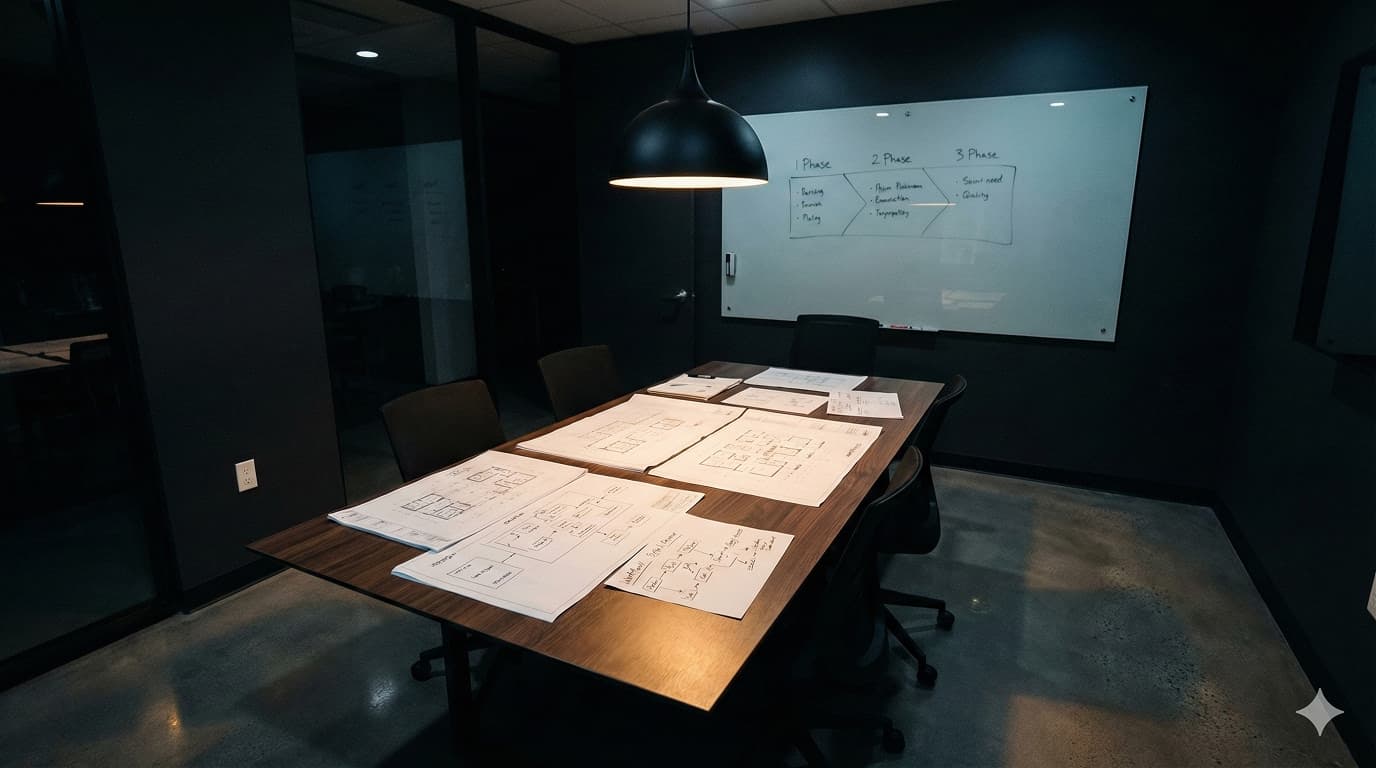
Visualize. Realize. Optimize.
Our Methodology
Three Phases. Clear Deliverables.
We don't know where you are in your journey. You may be early. You may already have a strategy and need us to bring rigor to move it along. Our methodology meets you where you are — plug in at any phase.
Define the AI-augmented operating model and competitive target state.
End-to-end workflow mapping across your highest-value business functions.
Score every workflow by cost, profitability, and resource intensity.
Sequenced initiative backlog with dependencies, resources, and decision gates.
Assess data quality, accessibility, governance posture, and infrastructure gaps.
Evaluate integration types: workforce augmentation, autonomous agents, advanced analytics.
Visualize
Map operations, identify opportunities, design the target state.
Realize
Build agents, deploy models, integrate infrastructure.
Optimize
Monitor performance, refine workflows, scale what works.
Phase 01
Map the Landscape. Design the Target State.
Before we write a line of code, we build a complete picture of your current operations, data infrastructure, and organizational readiness. We identify where AI creates real leverage — and where it doesn’t yet — then design the target state architecture that guides everything that follows.

Operational Discovery
End-to-end workflow mapping, stakeholder interviews, and data infrastructure audit to understand how your organization actually works today.

Opportunity Identification
Systematic evaluation of every workflow against AI readiness criteria: data availability, process maturity, ROI potential, and regulatory constraints.

Target State Architecture
A detailed blueprint of the AI-augmented operating model — including agent topology, data pipelines, integration points, and governance requirements.
We start with structured stakeholder interviews across leadership, operations, and technical teams. Simultaneously, we conduct a data infrastructure audit — mapping data sources, quality, accessibility, and governance posture. We then map every candidate workflow end-to-end, identifying decision points, handoffs, bottlenecks, and data dependencies. The result is a comprehensive operational landscape that becomes the foundation for everything that follows.
A transformation roadmap with prioritized initiatives sequenced by impact and feasibility. A data readiness report documenting infrastructure gaps, quality issues, and governance requirements. A target state architecture document detailing the AI-augmented operating model. And an executive alignment deck that gives leadership a shared, evidence-based view of what AI transformation looks like for your organization.
Our assessment framework scores every candidate workflow across multiple dimensions: data readiness (availability, quality, volume), process maturity (standardization, documentation, exception handling), AI suitability (pattern recognition vs. creative judgment), integration complexity (API availability, system dependencies), and governance requirements (compliance, audit trails, access controls). This scoring drives the prioritized initiative backlog.
The Visualize phase concludes with a formal decision gate: a structured review of findings, prioritized opportunities, and the proposed transformation roadmap. Stakeholders validate assumptions, approve the initiative sequence, and commit resources for the Realize phase. Nothing moves forward without explicit alignment — this prevents the scope drift and misaligned expectations that derail most enterprise AI initiatives.
Key Deliverables
Transformation Roadmap: Prioritized initiative backlog sequenced by impact, feasibility, and organizational readiness.
Data Readiness Report: Infrastructure gaps, quality baselines, and governance requirements mapped to each initiative.
Target State Architecture: Agent topology, data pipelines, integration points, and governance framework for the AI-augmented operating model.
Executive Alignment Deck: A shared, evidence-based view of the transformation for leadership sign-off.
Phase 02
Build the Agents. Deploy the Infrastructure.
This is where the target state becomes operational. We design, build, and deploy the AI systems that do the work — agents, models, knowledge systems, and the orchestration infrastructure that ties them together. Every component is purpose-built for your domain and governed from day one.

Agent Design & Development
Purpose-built AI agents for your specific workflows — customer-facing assistants, internal operations agents, and multi-agent orchestration pipelines.

Knowledge System Architecture
RAG systems, vector stores, and knowledge graphs that turn your institutional knowledge into a structured, queryable layer any agent can draw from.

Integration & Orchestration
API integrations, event-driven pipelines, and the orchestration layer that coordinates multi-agent workflows across your existing systems.
Agent Orchestration Pipeline
Every request flows through a structured pipeline — routed, enriched with context, dispatched to specialized agents, and governed before any action is taken.
We follow an iterative build cycle: design, prototype, validate, harden, deploy. Each agent starts as a focused prototype scoped to a single workflow. We validate performance against defined accuracy and latency thresholds before hardening for production — adding error handling, fallback logic, monitoring hooks, and governance controls. Only then does it enter the production environment.
Production-deployed AI agents integrated into your existing workflows. RAG infrastructure with vector stores, embedding pipelines, and retrieval APIs. API integrations connecting agents to your CRMs, ERPs, data warehouses, and internal tools. An orchestration layer coordinating multi-agent workflows. Monitoring dashboards tracking accuracy, latency, and business impact. And a governance framework with audit trails, access controls, and compliance documentation.
Our builds span the full AI infrastructure stack: agent frameworks with structured tool use and memory management, vector databases for knowledge retrieval, embedding pipelines for continuous knowledge ingestion, model serving infrastructure optimized for your latency and throughput requirements, and CI/CD pipelines purpose-built for AI systems — including automated evaluation, regression testing, and staged rollouts.
Governance is built into every component from day one, not bolted on after deployment. Every agent action is logged with full audit trails. Access controls enforce least-privilege principles across all AI systems. Data handling policies are enforced at the infrastructure level. Model versions are tracked, and rollback procedures are tested before any production deployment.
Key Deliverables
Production Agents: Purpose-built AI agents deployed and integrated into your operational workflows.
Knowledge Infrastructure: RAG systems, vector stores, and embedding pipelines making institutional knowledge queryable.
Orchestration Layer: Multi-agent coordination, API integrations, and event-driven pipeline infrastructure.
Governance Framework: Audit trails, access controls, compliance documentation, and model versioning infrastructure.
Phase 03
Monitor Performance. Scale What Works.
Deployment is the beginning, not the end. We build continuous monitoring, performance tracking, and feedback loops that make your AI systems smarter with every interaction. When something works, we scale it. When something drifts, we catch it early.

Performance Monitoring
Real-time dashboards tracking agent accuracy, response quality, latency, throughput, and business impact metrics across every deployed system.

Continuous Refinement
Feedback loops that capture user corrections, edge cases, and model drift — feeding improvements back into agent behavior and knowledge systems.

Scaled Deployment
Extending proven patterns to new workflows, new teams, and new business units — with governance that scales alongside.
Continuous Feedback Loop
Every deployed system feeds performance data back through a structured refinement pipeline — catching drift early, routing improvements through human review, and continuously improving the models in production.
Every deployed system feeds telemetry into a centralized analytics engine. We track both technical metrics (accuracy, latency, error rates, throughput) and business metrics (task completion, user satisfaction, cost per interaction). Drift detection algorithms flag degradation before it impacts operations, triggering structured refinement workflows that route through human review before any model update reaches production.
Monitoring infrastructure with real-time dashboards and automated alerting. Performance baselines and SLAs for every deployed agent. A refinement pipeline that continuously improves agent accuracy and knowledge coverage. A scaling playbook documenting how to extend proven patterns to new workflows and teams. And ongoing optimization reports tracking ROI, performance trends, and improvement opportunities.
Our optimization infrastructure includes automated evaluation pipelines that benchmark agent performance against golden datasets, A/B testing frameworks for comparing model versions in production, drift detection systems monitoring distributional shift in both inputs and outputs, feedback ingestion systems that capture corrections and edge cases for retraining, and staged rollout infrastructure that validates improvements before full deployment.
The governance infrastructure built in the Realize phase is designed to scale. The same monitoring, audit trails, and access controls that govern one agent govern a hundred. As you extend AI to new workflows and teams, the governance framework expands with it — ensuring that scaling velocity never outpaces compliance posture or operational control.
Key Deliverables
Monitoring Infrastructure: Real-time dashboards, automated alerting, and performance baselines for all deployed systems.
Refinement Pipeline: Continuous improvement infrastructure: feedback capture, evaluation, and staged model updates.
Scaling Playbook: Documented patterns and procedures for extending AI to new workflows, teams, and business units.
Optimization Reports: Ongoing ROI tracking, performance trends, and identified improvement opportunities.

Ready to Transform How Your Enterprise Operates?
Tell us where you are in your AI journey. We'll map the path from here to operating with AI at scale.
FAQs
Common questions about how we work, what we build, and what it takes to move from experimenting with AI to operating with it.
It means going beyond buying AI tools. AI transformation is about redesigning how your organization works — restructuring workflows, redefining roles, deploying agents and custom models, and building the governance infrastructure to manage it all at enterprise scale.
Using ChatGPT or Copilot is a starting point, not a strategy. A transformation partner helps you move from ad hoc AI usage to systematic integration — purpose-built agents embedded in your workflows, custom models trained on your data, and governance frameworks that make it all enterprise-safe.
Agents handle specific tasks — analyzing data, routing requests, generating reports. Infrastructure is everything that keeps those agents reliable, compliant, and maintainable: monitoring, audit trails, access controls, model versioning, and the orchestration layer that ties them together.
Governance is built into every engagement from day one. We design audit trails, access controls, data handling policies, and compliance frameworks tailored to your industry — whether that’s SOX, HIPAA, SOC 2, or internal enterprise standards.
We work primarily with technology companies, large enterprises, and PE/VC-backed portfolio companies across finance, healthcare, telecommunications, manufacturing, and professional services. Our approach adapts to any regulated or complex enterprise environment.
It depends on scope. A focused agent deployment can take 4–8 weeks. A full workflow redesign with custom model development and governance infrastructure is typically a 3–6 month engagement. We scope every project during the Visualize phase before committing to timelines.
Both. For many use cases, fine-tuned versions of leading foundation models deliver excellent results. For enterprises with proprietary data and domain-specific requirements, we develop fully custom models. We recommend the right approach based on your data, use case, and cost considerations.
We integrate with your team, not replace them. Our engagements are designed to build internal capability — we work alongside your engineers, transfer knowledge throughout the process, and leave your team equipped to maintain and evolve the systems we build together.
Visualize: we map your current operations, identify AI opportunities, and design the target state. Realize: we build and deploy agents, models, and infrastructure. Optimize: we monitor performance, refine workflows, and scale what’s working. Each phase has clear deliverables and decision points.
Schedule a consultation. We’ll discuss where your organization stands today, where you want to go, and whether Mashbot is the right partner to get you there. No pitch decks — just a conversation about your business.
Still have questions?
Tell us what you're working on. We'll tell you if we can help.